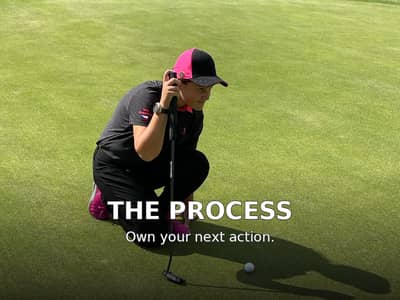
The Scoreboard ProblemEvery athlete wants to win. That is normal, and it is not the problem. The problem starts when the scoreboard (or any other outcome) becomes the only thing you pay attention to. Points, rankings, selection, stats, and comparisons are all outcomes. They matter, but you cannot act on them directly. You cannot score the next goal by thinking about the final score. You cannot make the team by staring at the roster. In the moment, the only thing you can act on is your next action. That is the heart of what we call: The Process: the daily, disciplined commitment to elite habits and to executing every task, rep, and play at the highest possible level, focusing on the inputs you control in the present moment, not the outcomes you don’t.
It sounds simple. It is not easy. But it is one of the most reliable ways to improve performance and protect your mental health at the same time. What The Process Looks Like in PracticeThe Process is not a slogan. It is a set of behaviours you can see, measure, and repeat. Here is what it means day to day. Live elite daily habits. Sleep, nutrition, hydration, rest, recovery, mobility, activation, and mental health are part of the job, not extras. The work you do away from the rink, pitch, or course sets the ceiling for what you can do on it. Inputs over outputs. Points, scores, rankings, and comparisons are outputs. You can’t control them in competition or chase a distant goal directly. You can control what you do right now. Define, then break it down. Use neutral thinking to identify what must be done (X, Y, Z), then turn it into micro goals you can execute one at a time. Neutral thinking strips away the drama and asks one question: what does this situation require? Discipline over feeling. Feelings are overrated. Some days you will feel sharp. Many days you won’t. Discipline lets you execute consistently, especially on days you don’t feel 100%. Present-moment focus. Wanting to win is normal. But in the moment, you can’t act on the result, only on the next action. Drive the next action. Use your ABCs or technical power thoughts to direct what you do next. A short cue like “quick feet, eyes up” gives your attention somewhere useful to go. Take pride in your work. Own the quality of every rep, whether anyone is watching or not. The short version: Build elite habits. Control the controllables. Execute the next action with discipline and pride. Let the outcome take care of itself. Why The Process Drives The Mental GameThe research is clear: what you aim at shapes how you perform. In mental performance, separate goals into three types. Outcome goals are about results (win the game). Performance goals are about personal standards (shoot 80% from the line). Process goals are about the actions that produce those standards (elbow in, follow through). A recent meta-analysis pooled 27 goal-setting studies in sport. Process goals had by far the largest effect on performance (d = 1.36), compared with performance goals (d = 0.44) and outcome goals (d = 0.09). Process goals also produced large gains in self-efficacy, the belief that you can execute (Williamson et al., 2024). In plain terms: athletes who focused on how to do the task performed far better than those focused on the result. Why? Attention is limited. Every bit of it spent on the scoreboard, the scout in the stands, or last shift’s mistake is attention not available for the next play. Process focus points your attention at the one thing that can actually change the outcome: what you do next. It also builds confidence on evidence, not hope. Each executed rep is proof you can do the work. (More on that in Mastering Confidence in Sport.) The same logic applies to daily habits. When Stanford basketball players extended their sleep to about 8.5 hours a night over several weeks, free throws improved from 7.9 to 8.8 makes out of 10, sprint times dropped, and mood improved (Mah et al., 2011). Nobody won a game by thinking about sleep. They won by building the input that made better performance possible. Why The Process Protects Mental HealthThe Process is not only a performance tool. It is a mental health tool, because it changes where you get your sense of worth. When success is defined only by outcomes, your mood rides the scoreboard. A loss, a benching, or a bad stat line becomes a verdict on who you are. That is a heavy load, and it is a common path to anxiety, frustration, and burnout. When success is defined by effort, learning, and quality of execution, you have something you can earn every single day, regardless of the result. Achievement goal research backs this up. A 2024 meta-analysis found that mastery-focused environments, where success means improvement and effort, were linked to more positive emotion and satisfaction and less negative emotion than ego-focused environments built on outperforming others (Lochbaum & Sisneros, 2024). The reason is control: when your definition of success is effort and execution, it is always within reach, which helps guard against performance anxiety. (See also Performance Anxiety in Sport.) The habits side matters too. The International Olympic Committee’s consensus statement makes the point that mental and physical health cannot be separated, and that mental health symptoms can impair performance and slow injury recovery (Reardon et al., 2019). Sleep, nutrition, recovery, and asking for help when you need it are not soft extras. They are the foundation. (More in Athlete Wellbeing.) One more benefit: The Process gives you a way back after a bad day. You don’t need to fix the season. You need to win the next rep, the next practice, the next night of sleep. That shrinks overwhelming problems into actions you can take, which is exactly what a struggling mind needs. Success, Redefined“Success is peace of mind, which is a direct result of self-satisfaction in knowing you made the effort to become the best of which you are capable.” — John Wooden Wooden won 10 NCAA championships at UCLA, yet he rarely talked to his players about winning. He coached the details, down to how they put on their socks. His definition of success is The Process in one sentence: success lives in the effort and the execution, and peace of mind follows. Legendary NFL coach Bill Walsh said the same thing in the title of his book: The Score Takes Care of Itself. 7 Ways to Build and Execute Your Process1. Sort your controllables. Draw two columns: “I control” and “I don’t control.” Effort, attitude, preparation, body language, sleep, and your next action go on the left. Refs, opponents, ice time, and the score go on the right. Spend your energy on the left column only. 2. Turn every outcome goal into process goals. Take one result you want (e.g., “score more goals”) and ask: what actions produce that? Then list two or three you can do this week, like “shoot within one second of receiving the puck” or “20 extra release reps after practice.” 3. Build your daily non-negotiables. Pick three to five habits: a set bedtime, hydration through the day, a pre-practice activation, a 10-minute recovery routine, a daily mental reset. Anchor each one to an existing cue, like “after I brush my teeth.” Expect it to take time; in one well-known study, new daily habits took a median of 66 days to become automatic, and missing a single day did not derail the process (Lally et al., 2010). 4. Write if-then plans. Decide in advance how you will respond: “If I make a mistake, then I take one breath, say my reset word, and attack the next play.” Plans in this if-then format had a medium-to-large effect on reaching goals across 94 studies (Gollwitzer & Sheeran, 2006). 5. Choose your power thoughts. Pick one or two short technical cues for your sport, like “eyes up, quick hands” or “smooth tempo.” Use them to pull your attention back to the next action whenever it drifts to the score or a mistake. 6. Execute on the flat days. When you don’t feel like it, shrink the task rather than skip it. Do the warm-up. Hit the first rep. Go to bed on time. Discipline is doing the basics well when motivation is low. 7. Grade the process, not just the result. After each practice or game, rate yourself 1 to 10 on your controllables: effort, focus, body language, execution of your process goals. Note one thing you did well and one thing to improve. This builds a record of evidence you can trust. ReflectThe outcome will come and go. Your process is what you own. Think about your last tough game or practice. How much of your attention was on the scoreboard, and how much was on the next action you could control? What is one habit or process goal you will commit to this week, even on the days you don’t feel like it?
ReferencesGollwitzer, P. M., & Sheeran, P. (2006). Implementation intentions and goal achievement: A meta-analysis of effects and processes. Advances in Experimental Social Psychology, 38, 69–119. https://doi.org/10.1016/S0065-2601(06)38002-1 Lally, P., van Jaarsveld, C. H. M., Potts, H. W. W., & Wardle, J. (2010). How are habits formed: Modelling habit formation in the real world. European Journal of Social Psychology, 40(6), 998–1009. https://doi.org/10.1002/ejsp.674 Lochbaum, M., & Sisneros, C. (2024). A systematic review with a meta-analysis of the motivational climate and hedonic well-being constructs: The importance of the athlete level. European Journal of Investigation in Health, Psychology and Education, 14(4), 976–1001. https://doi.org/10.3390/ejihpe14040064 Mah, C. D., Mah, K. E., Kezirian, E. J., & Dement, W. C. (2011). The effects of sleep extension on the athletic performance of collegiate basketball players. Sleep, 34(7), 943–950. https://doi.org/10.5665/SLEEP.1132 Reardon, C. L., Hainline, B., Aron, C. M., et al. (2019). Mental health in elite athletes: International Olympic Committee consensus statement (2019). British Journal of Sports Medicine, 53(11), 667–699. https://doi.org/10.1136/bjsports-2019-100715 Williamson, O., Swann, C., Bennett, K. J. M., Bird, M. D., Goddard, S. G., Schweickle, M. J., & Jackman, P. C. (2024). The performance and psychological effects of goal setting in sport: A systematic review and meta-analysis. International Review of Sport and Exercise Psychology, 17(2), 1050–1078. https://doi.org/10.1080/1750984X.2022.2116723 |